
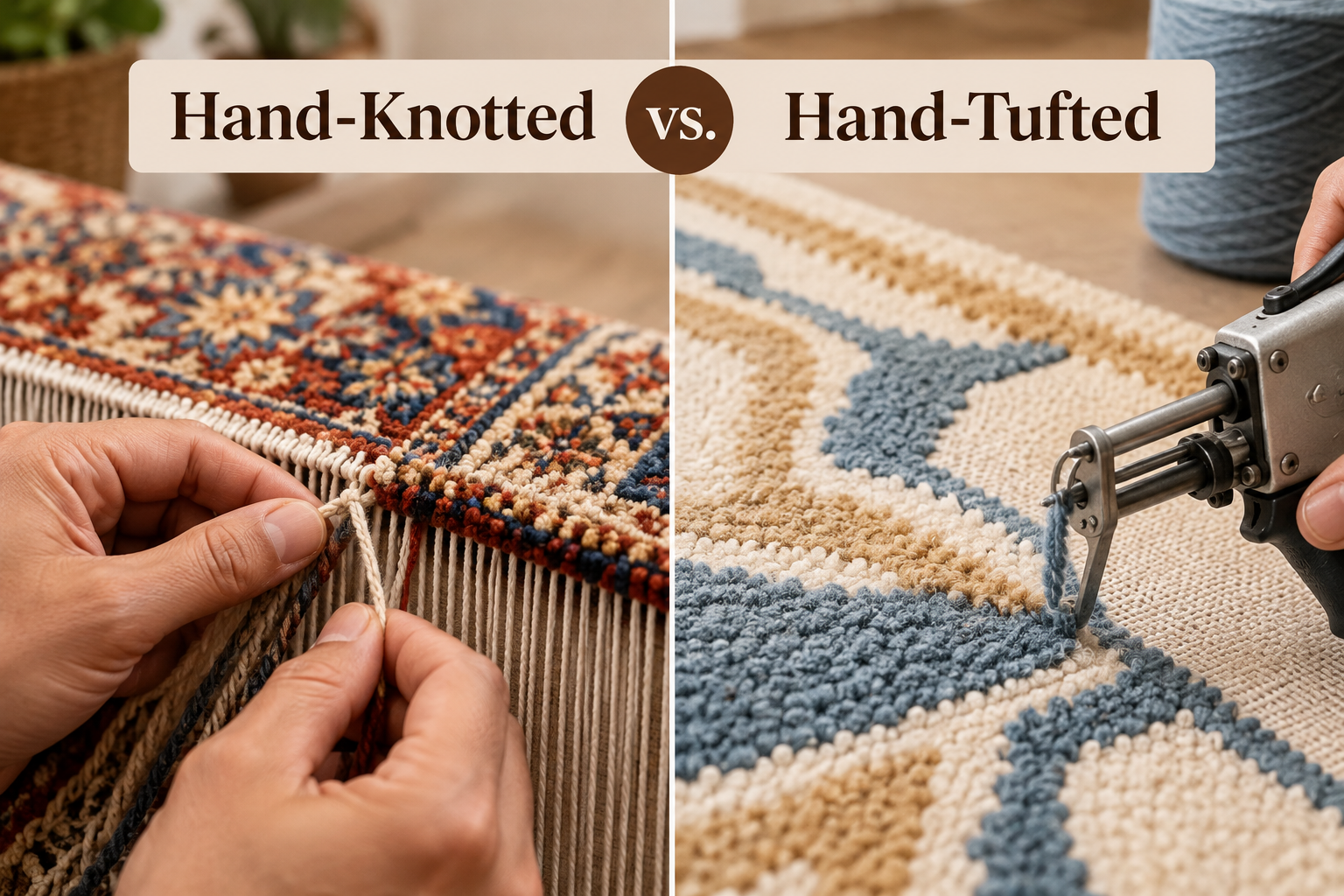
When shopping for a handmade rug, choosing between different styles can be just as important as choosing the right color or pattern. Hand-Knotted vs. Hand-Tufted Rugs is one comparison worth understanding before you buy. While both are handcrafted and can bring warmth, texture, and character to a room, their construction methods are quite different; and that can affect everything from durability and feel to price and lifespan.
At first glance, hand knotted rugs and hand tufted rugs may look nearly identical. The real difference is hidden within the rug itself: one is created by tying individual knots by hand, while the other uses a tufting tool to insert yarn into a foundation. Understanding that difference can help you choose a rug that fits not only your décor, but also your lifestyle and budget.
The easiest way to understand the difference is to look at the construction process.
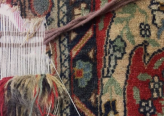
A hand-knotted rug is created by tying individual knots around the foundation threads. Each knot is secured by hand before the next one is made. Depending on the rug’s size, knot density, and design complexity, this can be an extremely time-consuming process.
Hand-tufting takes a different approach. An artisan uses a handheld tufting tool to push yarn through a fabric foundation, following the desired pattern. Once the design is complete, the rug is usually finished with a backing to hold the fibers securely in place.
In simple terms, hand-knotting is a knot-by-knot construction, while hand-tufting inserts yarn into a foundation. That difference influences nearly everything else about the rug.
If you’re looking for a rug that can become a lasting part of your home, hand-knotting is often the preferred choice.
The individual knots create a strong structure that can handle regular use. High-quality hand knotted area rugs can remain beautiful for decades when properly maintained, and exceptional pieces can even become family heirlooms.
Natural wool is particularly well suited to this construction. Hand knotted wool rugs are naturally resilient, comfortable underfoot, and versatile enough for both traditional and contemporary interiors.
Another advantage is design detail. Because artisans work knot by knot, hand-knotting allows for highly detailed patterns and subtle variations that contribute to the character of the finished rug.
This is one reason traditional styles such as hand knotted Persian rugs and hand knotted Oriental rugs continue to be valued by homeowners and collectors.
Hand-tufted rugs offer many of the visual benefits associated with handmade rugs, but their production is generally faster.
Rather than tying each individual knot, the artisan uses a tufting tool to create the pattern. This reduces production time and typically makes the rug more affordable than a comparable hand-knotted piece.
A hand tufted wool rug can still offer the warmth, softness, and natural appearance of wool. These rugs are available in a wide range of colors, patterns, textures, and contemporary designs.
For someone updating a room, experimenting with a new interior style, or furnishing a space without making a major long-term investment, hand tufting can be an attractive option.
The trade-off is that hand-tufted construction generally does not offer the same longevity as a well-made hand-knotted rug.
Hand-knotted rugs generally have the advantage when durability and longevity are the priority.
Because the yarn is secured through individual knots, the construction is designed to withstand years of use. With proper care, a quality hand-knotted rug can remain in excellent condition for decades.
Hand-tufted rugs can also be durable, but they are usually better suited to buyers who prioritize design and value over maximum lifespan.
This doesn’t make one construction universally better than the other. Think about the room first.
For a busy living room, hallway, or family space where the rug will receive frequent foot traffic, investing in a durable hand-knotted option may make sense. For a bedroom, guest room, or space where you enjoy changing your décor more often, a hand-tufted rug can provide excellent visual impact without the same investment.
Also Read: How to Identify Authentic Hand-Knotted Rugs?
Construction time is one of the biggest reasons for the price difference.
Hand-knotting requires an artisan to create thousands of individual knots, meaning a detailed rug can take a considerable amount of time to complete. As a result, hand knotted rugs are typically more expensive.
Hand-tufted rugs can be produced more efficiently, which generally results in a lower price.
When comparing prices, however, don’t look at cost alone. Consider the rug’s material, craftsmanship, knot density, size, design, expected lifespan, and where it will be placed.
A more expensive hand-knotted rug may offer better long-term value if you plan to keep it for many years. A hand-tufted rug may be the smarter choice if your priority is achieving a particular look at a lower upfront cost.
Instead of asking which construction is “better,” ask which one fits your lifestyle.
Choose hand-knotted if you want:
Choose hand-tufted if you want:
The right choice ultimately comes down to balancing style, function, budget, and longevity.
Two rugs can look almost identical from across a showroom but perform very differently over time. That’s why construction is worth considering alongside color, size, and pattern.
When shopping for hand tufted area rugs or hand knotted area rugs, ask about the fiber, foundation, backing, construction method, and recommended care. These details can help you understand what you’re actually buying and whether the rug is appropriate for your space.
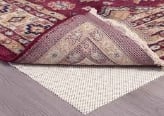
For traditional designs, you may also want to examine the back of the rug. Individual knots are typically visible on a hand-knotted piece, while a hand-tufted rug generally has a more recognizable backing.
Whether you’re drawn to the craftsmanship of hand knotted wool rugs or the design flexibility of hand-tufted styles, seeing rugs in person can make the comparison much easier.
At Rug Expo San Diego, you can explore a wide selection of handmade rugs in different materials, patterns, sizes, and construction styles. The team can help you compare options based on your room, lifestyle, design preferences, and budget.
The goal isn’t simply to find the most expensive rug or the trendiest design. It’s to find a rug that looks right today and makes sense for how you’ll use your space for years to come.
Are hand-knotted rugs better than hand-tufted rugs?
Not necessarily. Hand-knotted rugs generally offer greater durability and longevity, while hand-tufted rugs can provide handmade style at a lower price.
Are hand knotted wool rugs durable?
Yes. Wool is naturally resilient and works particularly well for rugs that receive regular use. A quality hand-knotted wool rug can last for decades with proper care.
Are hand knotted Persian rugs always hand-knotted?
Traditional authentic Persian rugs are generally associated with hand-knotting, but Persian-style designs can also be reproduced using other construction methods. Always check the rug’s actual construction.
Which rug is better for high-traffic areas?
A well-made hand-knotted rug is generally the better choice for high-traffic areas because of its strong construction and long lifespan.
How can I tell if a rug is hand-knotted?
Turn the rug over and examine its foundation. On a hand-knotted rug, you can typically see individual knots that correspond with the design on the front.
Do hand-tufted rugs last?
Yes, but generally not as long as comparable hand-knotted rugs. Their lifespan depends on the materials, construction quality, placement, and level of use.




























Leave a Comment